
Private Label vs White Label Supplements: Which Model Fits Your Dropshipping Business?
Private Label vs White Label, what is the difference? If you want to sell supplements under your own brand, these are usually your two main routes. Both mean you don’t build a factory. Both put your name on the bottle. The difference is who created the formula, and how much of it is truly yours.
That one difference drives almost everything a new seller cares about: how fast you can launch, how much cash you need up front, how easily a competitor can sell the same thing, and how much compliance work lands on your desk. This guide explains both models in plain terms, shows where the terminology gets slippery, and gives you a way to choose based on your own situation rather than a supplier’s sales pitch.
What are white label supplements?
A white label supplement is a finished formula that a manufacturer already makes and sells to multiple brands. You choose it, apply your label, and sell it as yours. The manufacturer owns the recipe. You own the brand.
Think of it like a restaurant buying its house sauce from a food producer. The sauce is good, it’s ready, and the restaurant’s name goes on the jar. Another restaurant might buy the same sauce and put a different name on it.
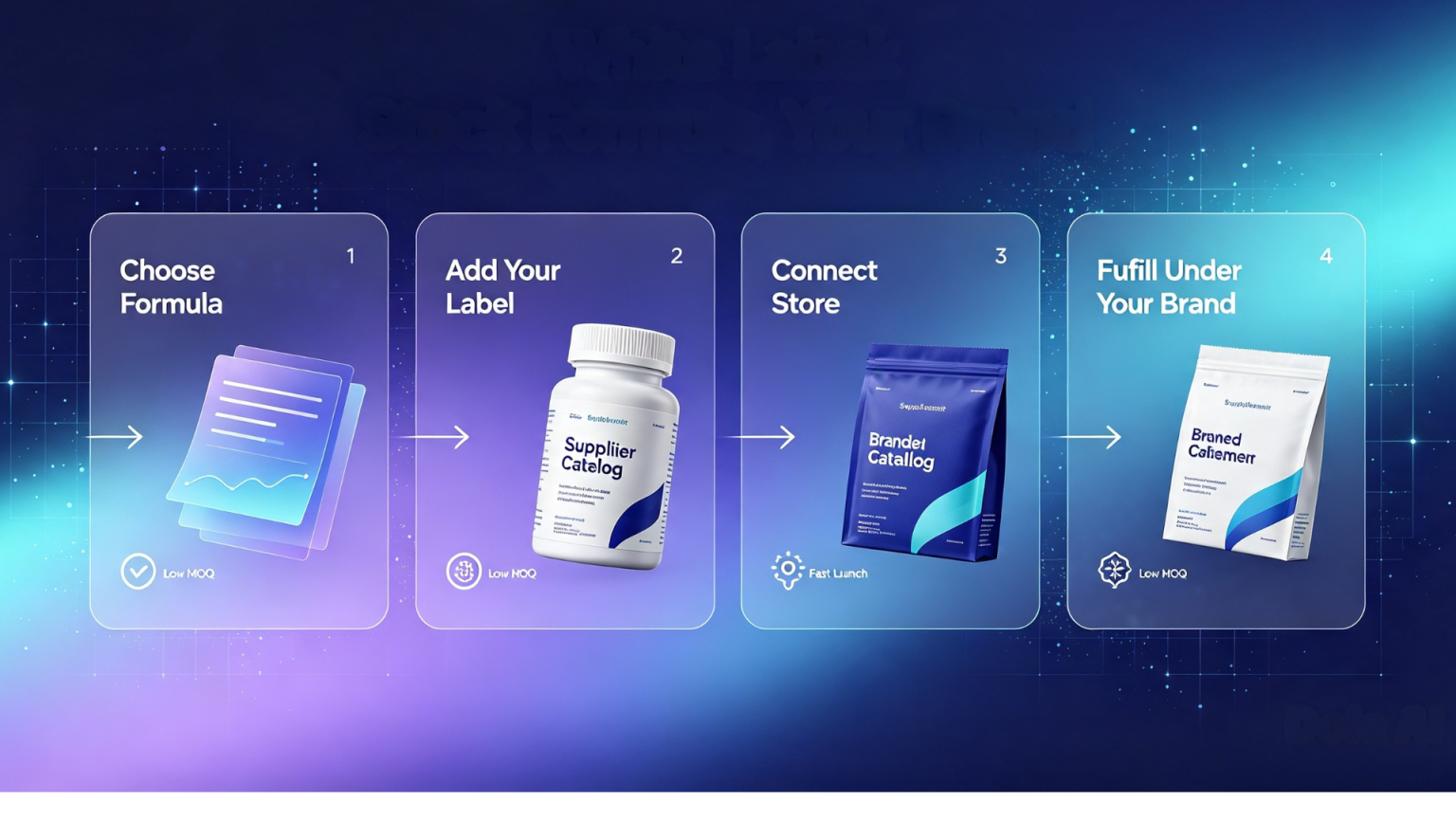
How white label works, step by step
- Choose a formula. You browse the supplier’s catalog of proven formulas and pick one that fits your audience.
- Customize the branding. You supply your brand name, logo and label design. The supplier applies it to the product and packaging.
- Set up your store. You connect your store so orders flow to the supplier automatically.
- Orders are fulfilled under your brand. When a customer orders, the product is picked, packed and shipped with your branding.
Because the formula already exists, ordering a stock formula under your own label usually carries a low or zero minimum order quantity (MOQ). That’s what makes white label so useful for testing.
What you can and can’t customize
You can normally change the brand name, logo, label design and packaging look. You normally can’t change the ingredients or dosages. If a customer says “I love it, but I wish it had less of X and more of Y,” white label can’t answer that. That request pushes you toward private label.
The main limitation: shared formulas
If the same formula is sold to other brands, then your product is only different on the outside. That matters more than it sounds. If a competitor with a bigger ad budget sells the identical formula, you can lose on price. Reviews, positioning and service become your real differentiators, not the product itself.
What are private label supplements?
Private label usually means the formula is made specifically for you. That can mean a fully custom recipe, or an existing base formula that’s adjusted and made exclusive to your brand. You decide the ingredients, dosages, format and flavor within what the manufacturer can produce and what regulations allow.
It’s a bigger commitment. But it’s also the only route that gives you a product nobody else can sell.
The contract manufacturer’s role
A contract manufacturer develops, tests and produces your formula to your specification. In practice, that usually involves:
- Discussing your product concept, target customer and format
- Developing or adjusting a formula
- Producing samples for you to evaluate
- Running production and quality checks
- Preparing documentation for the product
Custom formulation is typically a separate, higher-tier service with its own MOQ and upfront cost. Some suppliers only offer it to brands with an established sales history, because developing a formula is a real investment on their side too.
What you control, and what you take on
You control the formula, the format and the positioning. You also take on more:
- Development time. Getting a formula right takes rounds of samples and adjustments.
- Larger production runs. Custom products usually need a minimum order.
- More attention to claims and documentation. When the product is yours, so is the responsibility for what the label says.
- Planning around stock. You’ll need to forecast demand and manage reorders.
A warning about the terms
In this industry, “white label” and “private label” aren’t strictly regulated terms. Different suppliers use them differently. Some say “private label” for any product that carries your name, even if it’s a stock formula sold to many others. Others reserve it for exclusive custom formulas.
So don’t rely on the label. Pin down three things with any supplier:
- Exclusivity. Is this formula exclusive to my brand, or do other brands sell it?
- Changeability. Can I change ingredients or dosages? If so, under what MOQ and cost?
- Documentation. Which documents do I receive (specifications, testing records, traceability), and who holds the formula details?
If a supplier can’t answer these clearly, that tells you something on its own.
Private label vs white label: side by side
| White label | Private label | |
| Formula | Existing; may be shared with other brands | Custom or exclusive to your brand |
| What you customize | Brand name, logo, label, packaging | Ingredients, dosage, format, plus branding and packaging |
| MOQ | Usually low or none for stock formulas | Usually required |
| Time to launch | Days to a few weeks | Longer, because of development and sampling |
| Upfront cost | Low | Higher |
| Differentiation | Mostly brand and service | Formula, brand and service |
| Formula ownership | Held by the manufacturer | Depends on your agreement; confirm in writing |
| Flexibility to change product | Limited to available catalog | High, within regulatory limits |
| Main risk | Competing with the same formula | Money and stock tied up in an unproven product |
The real trade-offs
Speed vs differentiation
White label gets you to market fastest, because the hardest parts (developing and stabilizing a formula) are already done. Private label takes longer but gives you something defensible. If you’re still unsure anyone will buy, speed matters more. If you already know they will, defensibility matters more.
Cost vs control
The lower your commitment, the less control you have. White label keeps cash risk low but limits what you can change. Private label gives you control but asks for money and volume up front.
Compliance load
Both models require care with labels and claims. But with a custom formula, you’re deciding what goes in the product and how you describe it, so the burden of checking ingredients, dosages and claims for each market you sell in sits more heavily with you. Countries differ on ingredient status, maximum dosages, label language, claim rules and product registration, so a formula that works in one market may not work in another.
Perceived quality and reviews
With a shared formula, a batch problem or a viral bad review about the underlying product can affect every brand selling it. With an exclusive formula, your reputation depends on your own product and your own supplier choice.
Which model fits which seller
Here are three examples of the kinds of sellers we see. These are illustrative, not real customers.
1. The tester
You run a wellness or fitness store and want to know if supplements will sell to your audience.
Go white label. Pick a proven formula, brand it, and see how your customers respond before spending on development. A low or zero MOQ for testing means you’re not sitting on stock while you find out.
2. The brand builder
You’ve been selling a supplement for a while, customers keep reordering, and you’re hearing the same feedback about what to change.
Go private label. You have demand and specific ideas, and a custom formula lets you turn those into a product that’s yours alone.
3. The category expander
You already have an established store in a nearby category, and you want to add supplements without a big risk.
Start with white label to learn the category and the compliance basics. Add a custom product later, once you know what your customers respond to. If this is you, our guide to starting a supplement dropshipping business walks through the setup steps in more depth.
How to choose between White Label and Private Label?
Answer these six questions honestly. Each one points toward a model.
| Question | White label | Private label |
| Do you have proof people will buy this? | Not yet | Yes, with sales history |
| Where does your edge come from? | Brand, audience, service | The formula itself |
| Can you commit to a minimum order? | Not comfortably | Yes |
| How soon do you need to launch? | As soon as possible | You can wait for development |
| Do you have capacity to manage claims and documentation? | Limited | Yes, or you have advisors |
| Does it matter if others sell the same formula? | Not much | Yes, a lot |
If most of your answers land in the left column, start white label. If most land in the right, private label is worth the investment. If it’s split, start white label and plan to graduate.
Next, you will have to choose the right supplement product for your brand. Choosing a model is only half the decision. The other half is choosing the right product to build it around.
How to choose the right supplements to sell:
The path from stock formula to custom formula
Many strong supplement brands begin with a proven formula and later commission a custom one. It’s a practical way to spend money only after you’ve earned confidence.
Signs you’re ready to move
- Repeat purchases. Customers are reordering, which tells you the product works in real routines.
- Consistent feedback. Reviews and support messages keep pointing to the same wish (a different dose, a different flavor, an added ingredient).
- Price pressure. Others sell the same formula and you’re competing on price.
- Steady volume. Your order volume is predictable enough to commit to a minimum order.
How to prepare
- Keep a running list of customer requests and complaints.
- Note your sales history, since some suppliers ask for it before offering custom formulation.
- Ask your supplier early how the move works, what the MOQ and upfront cost would be, and how long development takes.
- Decide which parts you want exclusive (formula, flavor, format) and which can stay standard.
How dropshipping fits with each model
White label with dropship fulfillment
This is the classic version. A customer orders on your store, the order goes to your supplier, and the product is picked, packed and shipped under your brand. You hold no stock. A typical workflow runs: customer order, payment or exception check, order transmission, fulfillment queue, pick-and-pack, shipping, tracking update, customer notification.
Private label with fulfillment support
With a custom product, a batch is produced for you, so you need to plan for storage and reorders. You can still hand fulfillment to a partner, so you don’t ship parcels yourself. What changes is that you’re no longer purely “no inventory.” Build reorder points into your planning so you don’t run out or overproduce.
Common mistakes
- Assuming “private label” means exclusive. Ask, and get it in writing.
- Going custom too early. Paying for development before you know anyone wants the product.
- Ignoring the MOQ fine print. “No MOQ” may apply only to stock formulas or only to testing.
- Skipping samples. Always evaluate the product yourself before selling it.
- Copying claims from competitors. Their claims may not be compliant, and they’re not your protection.
- Selling everywhere at once. Rules differ by country, so build a country-by-product review before you turn on international shipping.
Questions to ask any supplier before you commit
- Is this formula exclusive to my brand, or shared?
- What is the MOQ for a stock formula, and what is it for a custom one?
- Which records come with the product (specifications, testing records, traceability)?
- Who is responsible for checking label claims?
- If I start on a stock formula, what does moving to a custom formula involve?
- Can I order samples, and what do they cost?
- What happens to my artwork and formula details if I move to a different supplier?
How MAX Dropshipping supports private label and white label dropshipping
MAX’s supplement dropshipping service is organized around the two models in this guide.
Fast Launch (white label): choose from proven supplement formulas, customize your brand in days, test with no MOQ required, and launch in as fast as 4 to 5 days. It’s designed for sellers who want to validate an idea without upfront inventory pressure.
Custom Brand (private label): create your own formula, develop unique products, fully customize your packaging, and launch within around 15 days. It’s designed for founders who already understand their market and want to build long-term brand value.
Formats include capsules and tablets, powders and stick packs, gummies, and functional drinks or strips. MAX has produced customized formulas for 80+ brands and 300+ custom labels, and connects to your store so orders flow automatically. See also our guide on how to start a supplement dropshipping business and our page on customizations.
FAQ
Is white label the same as private label?
Not always. White label generally means a ready-made formula with your branding on it. Private label generally means a formula made or tailored for you. Suppliers use the terms loosely, so ask what’s actually included rather than relying on the name.
Can I dropship private label supplements?
Yes. Once your custom product is made, it can be stored and fulfilled directly to your customers under your brand. The difference from white label dropshipping is that there’s usually a production run to plan for first.
Which is cheaper to start with, white label or private label?
White label. Stock formulas usually carry low or zero MOQs and no development cost, so your upfront spend is mostly branding and setup.
Can I switch from white label to private label later?
Yes, and many brands do. Some suppliers only offer custom formulation to brands with sales history, so starting on a proven formula and building that history is a sensible path.
Do I need to worry about regulations with white label?
Yes. Your name is on the label, so you share responsibility for accuracy and claims. In the US, the FDA requires dietary supplements to be produced under Good Manufacturing Practices, and you should confirm the labeling and regulatory requirements for every market you ship to. This guide is general information, not legal advice.
Will my customer know the product came from a third-party supplier?
With true white-label or private-label dropshipping, packaging, labels and often the return address are set up to appear as your brand, with no supplier packing slip in the box. Confirm the details with your supplier before you launch.
Ready to test your supplement idea?
Talk to a dedicated MAX agent about which path fits your product, or read more about MAX’s supplement dropshipping service.