
How Much Does It Cost to Launch a Supplement Line? A Cost Breakdown for New Brands
There’s no single number here, and anyone who gives you one without asking about your model is guessing. Launching a supplement line can cost very little, or a meaningful amount, depending on one decision made early: do you sell an existing formula under your own label, or build a formula that’s yours alone?
This guide breaks the cost into its real components so you can build a budget from actual supplier quotes, not from a headline figure that doesn’t match your situation. We’ve deliberately left dollar amounts out, because they shift by supplier, format, region and order size — what won’t shift is the list of things you need to price out. If you’re still deciding on a business model, read how to start a supplement dropshipping business first, and see is supplement dropshipping profitable for how these costs compare against typical margins.
What actually drives your total cost
Your launch model
A stock formula sold under your own label is the cheapest way in. The manufacturer has already done the expensive work: developing, testing and stabilizing the recipe. A custom formula flips that: you’re paying for development, sampling rounds, and usually a larger minimum order, because the manufacturer is taking on new work specifically for you. See our comparison of private label vs white label supplements for how the two paths differ beyond cost.
Number of products and formats
Every additional SKU multiplies several cost lines at once: formulation or adjustment work, label design, testing, and packaging tooling. Formats matter too — gummies, capsules, powders and drinks are produced on different lines with different setup costs, so a five-product line spanning three formats will generally cost more to launch than five variations of one format.
Where you plan to sell
Selling in one country is simpler and cheaper to launch than selling in several, because labeling, claims and sometimes formulation requirements differ by market. Expanding later is usually more cost-efficient than trying to be compliant everywhere on day one.
Cost breakdown, line by line
Formulation and product development
Near zero if you’re using a manufacturer’s existing stock formula under your own label. Meaningful if you’re commissioning a custom formula, since that typically involves discovery, sample rounds, adjustments, and stabilization testing before a formula is production-ready. Ask your manufacturer whether formulation is a flat fee, a per-round fee, or bundled into your first production order.
Minimum order quantities and your first batch
Stock formulas often carry low or zero minimum order quantities, especially for a first order aimed at testing. Custom formulas usually require a real minimum, sometimes alongside an upfront payment before development even starts. This is often the single largest line item for a private label launch, so get exact MOQ numbers, by format, in writing before you commit. Our guide on choosing a private label supplement manufacturer covers what to ask and what red flags to watch for at this stage.
Lab testing and quality documentation
Ask exactly what testing is included in a quote (identity, potency, contaminant and allergen testing are common categories) and what costs extra. Testing isn’t optional overhead — it’s what lets you back up label claims and respond credibly if a customer or platform ever asks questions.
Packaging and label design
This covers design work, printing, and physical materials (bottles, pouches, boxes, inserts). Standard packaging is cheaper and faster; custom packaging costs more up front but is a big part of what makes a product feel like a real brand rather than a private-labeled commodity. Note that packaging materials can carry their own MOQ, separate from the product MOQ, which is easy to miss when budgeting.
Legal, compliance and insurance
Budget time and money for reviewing your label and marketing claims for each market you plan to sell in, and for product liability insurance, which many retailers, marketplaces and payment processors expect as a baseline. This is one of the categories new brands most often skip entirely at launch and pay for later, at a worse time.
Storage and fulfillment
If you dropship, most of this cost is built into your per-order fulfillment fee rather than sitting as a separate upfront cost. If you hold your own inventory (more likely with a custom formula and a larger minimum order), budget separately for storage, and factor in any special handling for temperature-sensitive formats.
Marketing and launch budget
Often the largest cost after the product itself, and the easiest to underfund because it’s not tied to a specific supplier invoice. A common mistake is spending the entire starting budget on inventory and having nothing left to actually reach customers.
A practical way to estimate your own number
Because published figures vary so widely by supplier, region and format, the more useful exercise is building your own estimate from real quotes. A simple approach:
- List every line item from the breakdown above that applies to your model.
- Get at least three supplier quotes for the ones with the biggest range (MOQ cost, formulation, packaging).
- Separate one-time costs from recurring ones — a formulation fee happens once; fulfillment fees happen every order.
- Add a contingency, typically 10-20%, for the things every founder forgets the first time (a reprint after a label error, a compliance review, a slower-than-expected sample round).
- Compare the total against your expected margin, not just against what you can afford to spend, using our guide on supplement dropshipping profitability.
This mirrors how the US Small Business Administration recommends estimating startup costs for any small business: build the full list first, separate one-time from ongoing costs, and estimate each line from real quotes rather than a single published average.
Hidden costs new brands miss
Reorders and reformulations
Sales grow, stock runs low, and a customer request for a tweak (less sugar, a different flavor, a new dose) can mean a reformulation, which brings back testing and label costs you thought were behind you.
Expired or unsold stock
Supplements carry shelf lives. Ordering more than you can sell before expiry isn’t a theoretical risk — it’s one of the most common ways new brands lose money on an otherwise good product.
Shipping, returns and damaged goods
Return shipping, refunds for damaged or delayed orders, and replacement units all come out of margin. Confirm with your supplier or fulfillment partner who absorbs the cost when something goes wrong in transit, and build a small buffer into your pricing for it.
Compliance reviews you didn’t budget for
Expanding into a new country, adding a new claim to your marketing, or a platform tightening its supplement policy can all trigger a review you didn’t plan for. Treat compliance as an ongoing line item, not a one-time launch cost.
What Sellers Should Know Before Starting a Supplement Brand
Common budgeting mistakes new brands make
Pricing the product before pricing the whole launch
It’s tempting to get a per-unit product quote and treat that as “the cost.” But the per-unit price rarely includes packaging design, testing, compliance review, or your first month of marketing. Build the full line-item list before you commit to a retail price.
Treating the first supplier quote as the market rate
Quotes for formulation, packaging and testing can vary significantly between manufacturers for reasons that have nothing to do with quality — different equipment, different regional costs, different minimum batch sizes. Get at least three quotes before assuming you know your real cost.
Underestimating the cost of getting a formula right
If you’re commissioning a custom formula, budget for more than one sample round. First formulas rarely land exactly right on taste, texture or stability, and each additional round of adjustment and testing has its own cost and timeline.
Spending the whole budget before a single customer sees the product
A common pattern: all available capital goes into inventory and packaging, leaving nothing for marketing at launch. A product nobody has heard of doesn’t sell itself, however good the packaging is.
Not planning for a second order
Founders often budget for the first production run in detail and then get surprised by reorder costs, which can differ from first-order costs (some suppliers offer first-order discounts, others require larger reorder minimums). Ask about both scenarios up front.
Plan your launch with MAX
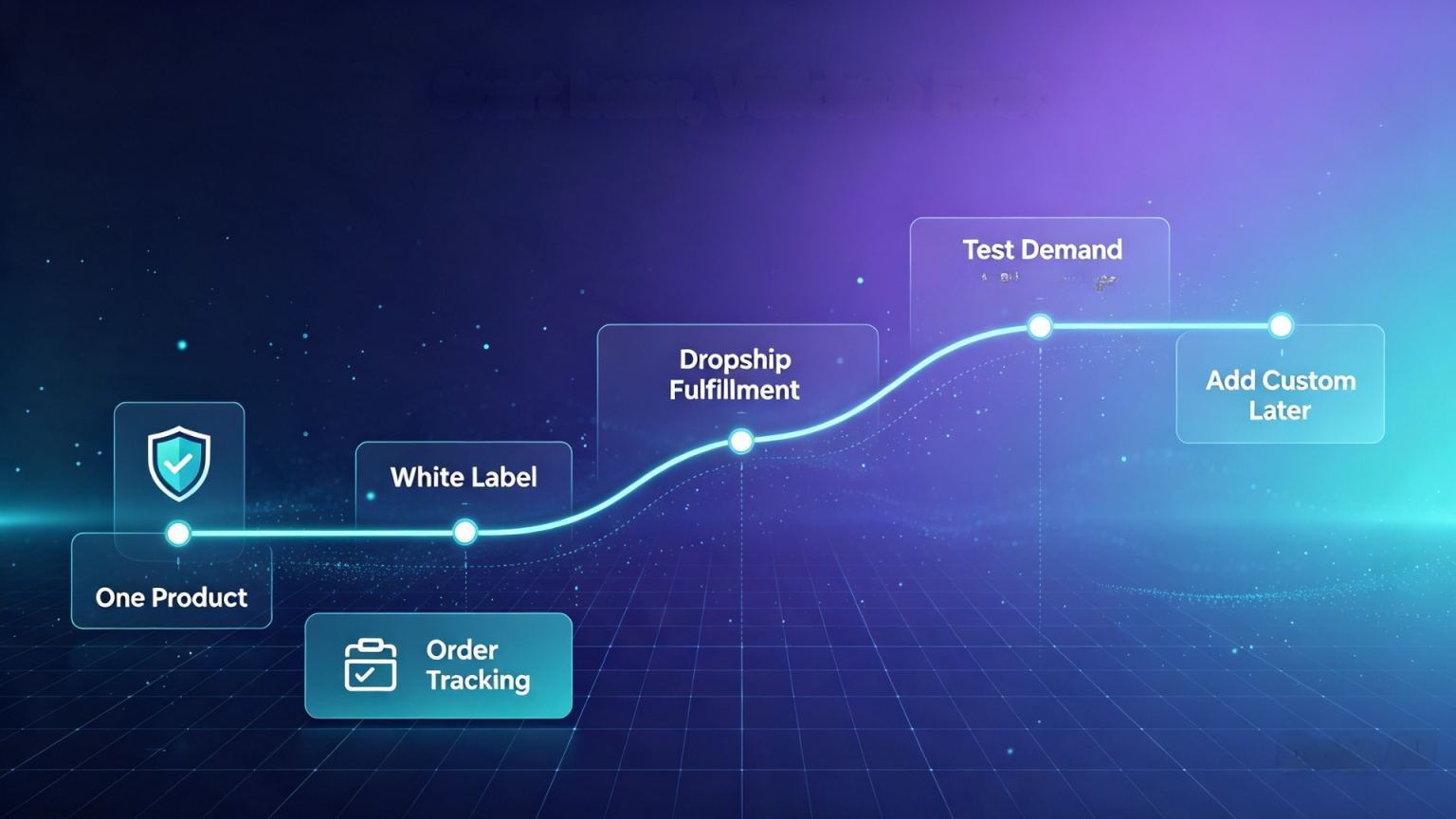
MAX Dropshipping built for the lean approach in this guide: choose from proven supplement formulas, customize your brand in days, test with no MOQ required, and launch in as fast as 4 to 5 days. Once a product proves out, the Custom Brand path covers your own formula and fully customized packaging, with a launch in around 15 days. Check with your MAX agent for a quote built around your specific product plan.
FAQ
What’s the cheapest way to start selling supplements?
White label combined with dropship fulfillment. You customize the branding, pay per order rather than holding inventory, and skip development costs entirely, at the trade-off of less product differentiation.
Is a custom formula worth the extra cost?
It depends on whether you already have proof people want the product. If you have sales history and specific customer feedback pointing to a change, a custom formula turns that demand into something only you can sell. Without that proof, it’s a larger bet on an unproven idea.
How do I know if my numbers make sense?
Compare your total launch cost and your per-unit cost against realistic margins for the category, not against how much money you have available to spend. See our guide on whether supplement dropshipping is profitable for how to think about that comparison.